

Contractors
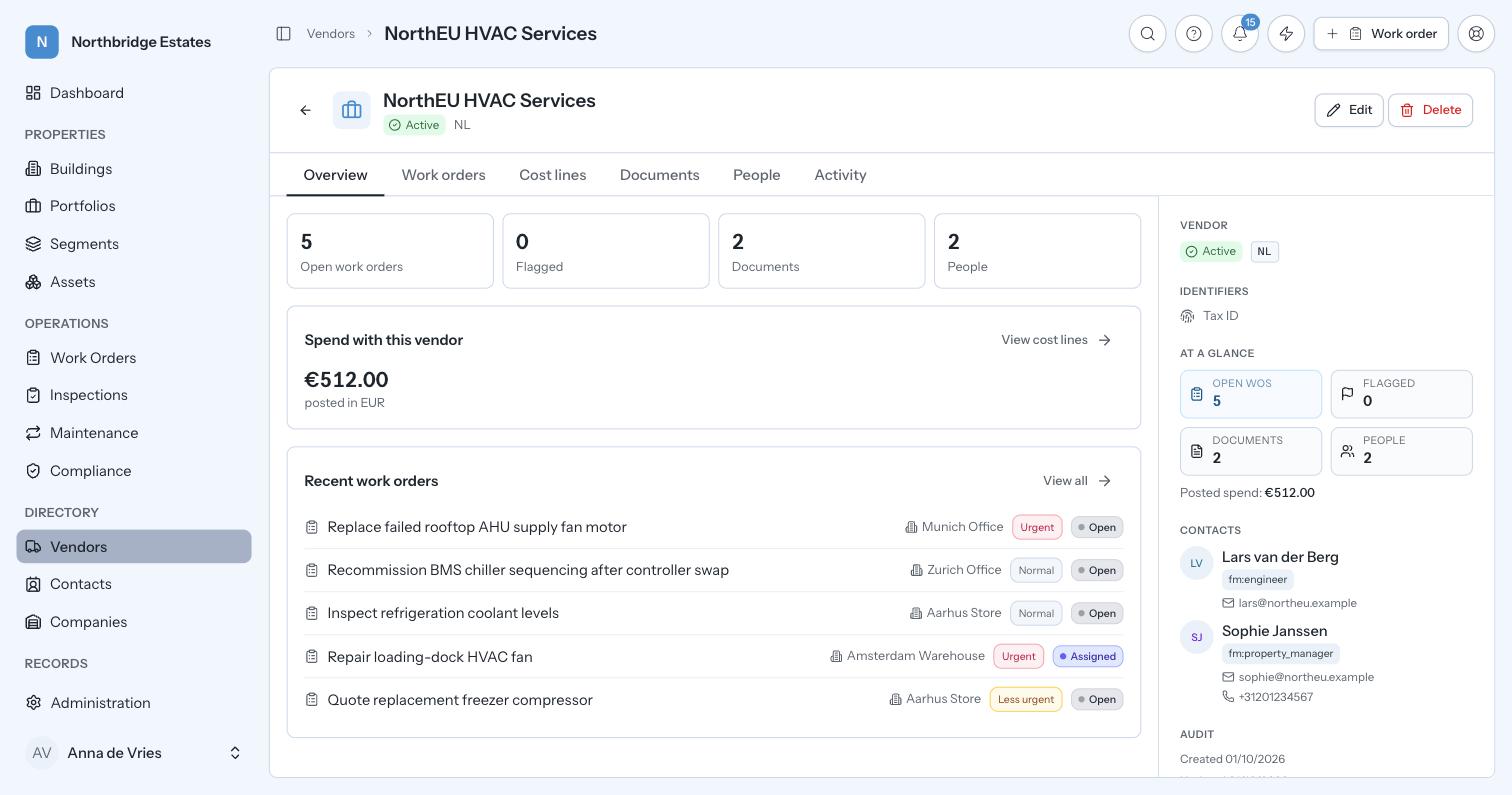
Insurance, contracts and spending limits as live records with dates on them, not folders somebody forgot to open. Contractors and suppliers sit in one central register with their service agreements,…
 English (UK)

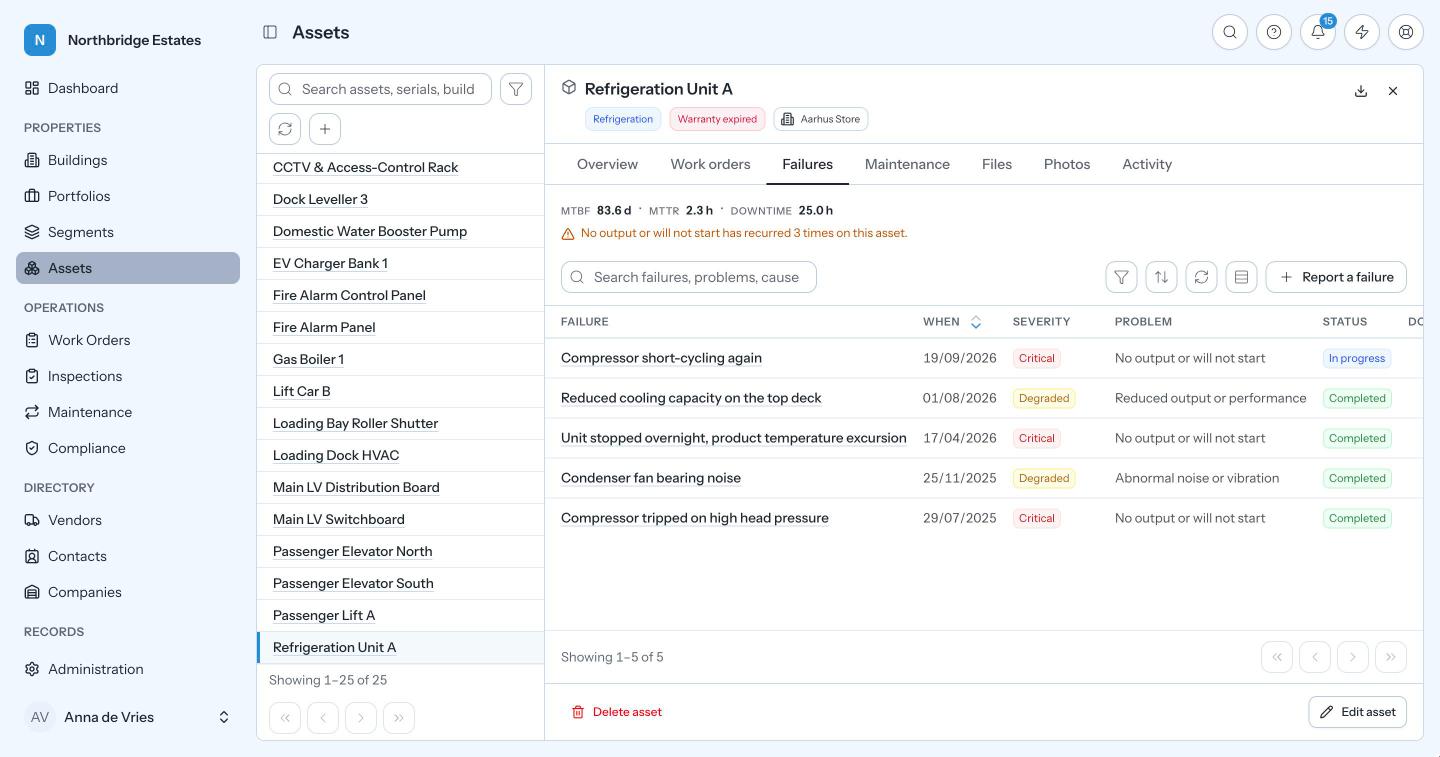
Coding failures the same way every time is what makes recurrence countable.
When a job closes on a breakdown, Prova captures the closure in a standard shape: problem, cause, remedy, severity and downtime. The vocabulary comes from a failure code catalogue your organisation owns and edits, so the same fault is coded the same way every time and by everyone.
Coding failures consistently is what makes recurrence countable. It turns a stack of individual repairs into mean time between failures and mean time to repair, per asset, per category and per site. That is the evidence you need to argue for replacing a machine rather than repairing it a fourth time, and to identify the contractor whose fixes do not hold.
Failure record
Problem, cause, remedy, severity and downtime, captured at closure rather than reconstructed later.
Failure codes
A catalogue you own and edit, not a fixed vendor taxonomy.
Derived measures
Mean time between failures and mean time to repair, per asset, per category and per site.
In practice
The Rotterdam chiller has to be replaced, and somebody has to justify the capital.
The capital request stops being “it keeps breaking” and becomes an interval, a trend, a downtime figure and a cost. It also identifies the opposite case: a contractor whose repairs do not hold shows up as the same code returning on the same asset, which is evidence rather than suspicion.
Illustrative walkthrough. Not a customer record.
You do. It is an organisation-owned catalogue that you edit, which is what keeps the coding consistent with how your team actually talks.
The coding happens at closure, as part of finishing the job. The reporting is a consequence of that, not a separate exercise somebody has to remember to do.
Next step
Thirty minutes on your own estate: your buildings, your obligations and your numbers. We will show you where the time and the money are going.
Book a demo